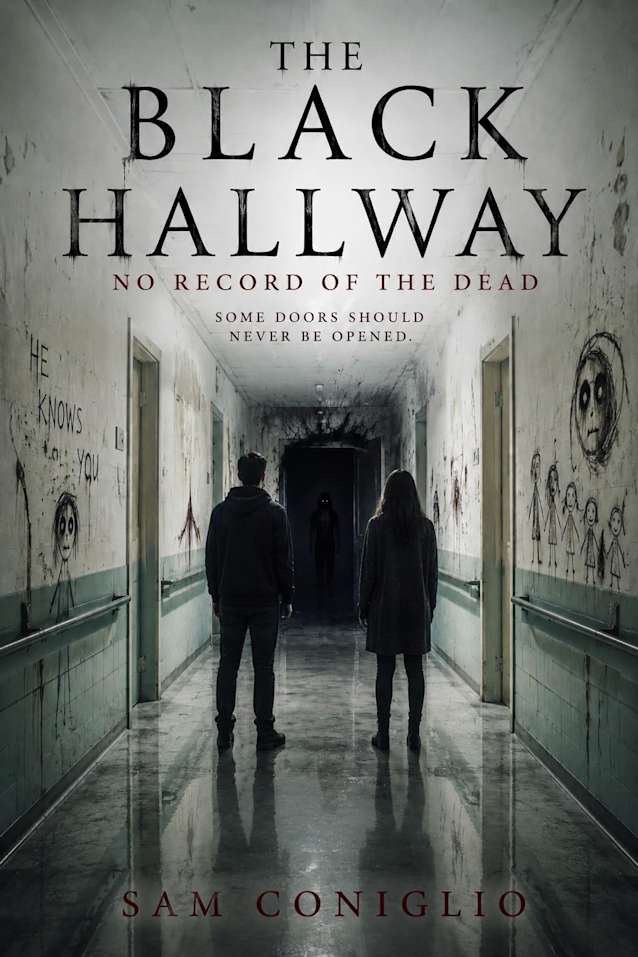
THE BLACK HALLWAY: NO RECORD OF THE DEAD
About
THE BLACK HALLWAY: No Record of the Dead
A Black Hallway Novel — Book Two
Renata Vasquez doesn’t believe in ghosts. Seven years covering crime and disappearances for the Pittsburgh Courier have taught her that the world is strange enough without inventing additional strangeness. She believes in evidence, in her two-column legal pad, and in the principle that every mystery has a source if you’re willing to follow it far enough.
Then a cassette tape arrives at her desk in a bubble-wrap envelope with no return address and a single word on the label: DISMAS.
On the tape, a young woman explores an abandoned psychiatric hospital, narrating what she finds with the steady precision of someone who does this for a living — impossible corridor geometries, rooms where the dimensions shift depending on which direction you walk, and walls covered floor to ceiling in black rectangles drawn and redrawn so many times the marker has soaked through to the stone beneath. Inside the rectangles, rendered in detail no one would put into a figure meant to be read as distant, stand figures that are tall and very thin.
At forty-three minutes and seventeen seconds, a second voice appears. No door. No footstep. Just a woman’s voice, calm and unhurried, speaking from somewhere inside the walls. A woman who says she came to look and stayed longer than she meant to. A woman named June. A woman for whom no record exists anywhere.
Three days later, a photograph arrives. A young woman at the building’s fence, grinning, headlamp on her forehead, patches on her jacket. Four words on the back: Her name is Leah. Leah Pierce, twenty-eight, urban explorer. Missing for twenty-three days. The police searched the accessible sections of Saint Dismas Psychiatric Hospital and found signs she had been there. They found nothing else.
What moves Renata from research to action isn’t the impossible voice or the drawings or the 1971 photograph she finds in the Courier’s archive showing a shape at the end of a basement corridor that shouldn’t be there. It’s the absence of any record that June exists at all. That is a story she knows how to follow.
What she finds inside Saint Dismas will require her to revise everything she thought she understood about what a building could be and what grief could do when it had somewhere to go. The building has been operating since 1897, and it has spent all of that time accumulating the suffering of the people who passed through it, organizing that suffering into something structural, something with rooms and corridors and its own rules about time and distance and who gets to leave.
And at the bottom of it, in the deepest layers of what the building has become, something has been waiting with a patience that makes every human conception of patience seem like a first draft. It has been watching the people who come through the building for over a hundred years. It has been learning. And it has been waiting for someone with the exact right combination of intelligence, grief, and refusal to look away.
It has been waiting for Renata.
The Black Hallway: No Record of the Dead is a literary horror novel about the architecture of loss, the spaces grief occupies when it has nowhere else to go, and what happens when a journalist who has spent her career documenting things that can’t be explained finally encounters something that can’t be explained. It is a book about the people we lose, about the difference between love and the reconstruction of love, and about the particular kind of courage it takes to keep walking toward the living when everything you loved about the dead is pulling you back.
Some doors should never be opened. Some buildings remember everything. And some things that have been waiting in the dark have been waiting long enough to know exactly who they’re waiting for.
The Black Hallway: No Record of the Dead is available now.